
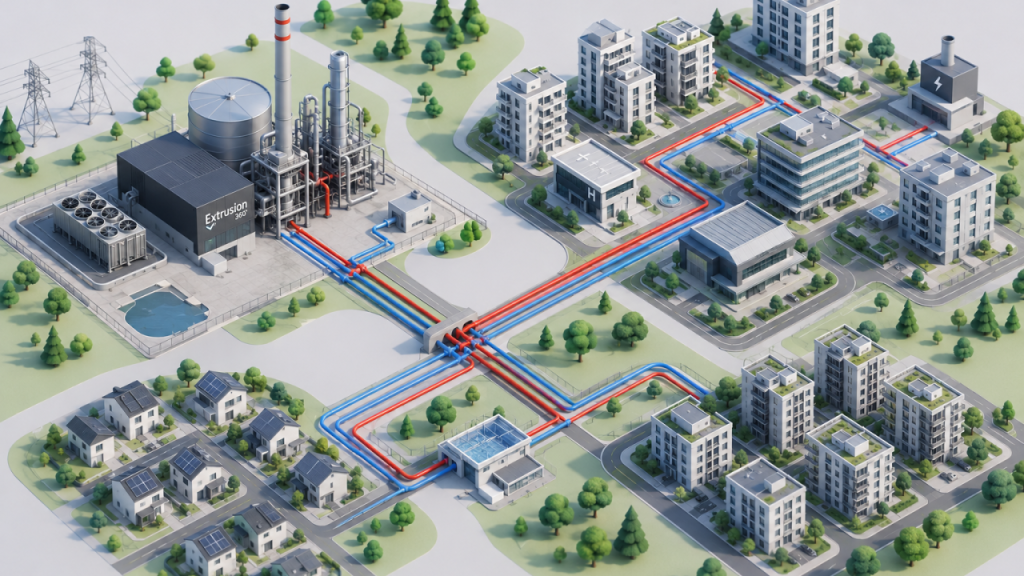
District heating and cooling networks are only as reliable as the buried pipe inside them. Everything else, including pumps, substations, and heat sources, depends on a pressurised, thermally insulated pipe system capable of operating for decades under thermal cycling, soil movement, and mechanical stress. The pipe network is also where much of the engineering complexity, material selection, lifecycle cost, and regulatory compliance sit.
This article explains how district heating and cooling pipes are constructed, how they are manufactured, which materials are used at different network levels, what realistic service lifetimes look like, and how low-temperature heating and Europe’s evolving energy policy are reshaping the sector.
Heating and cooling account for a significant share of Europe’s final energy consumption. According to Euroheat & Power, district heating currently supplies approximately 13 percent of Europe’s heat demand through nearly 19,000 systems and around 200,000 km of network length, with a combined installed capacity of roughly 300 GW.
The revised EU Energy Efficiency Directive (EED 2023) progressively increases the renewable and waste-heat requirements associated with the definition of efficient district heating and cooling systems. As Europe moves toward lower-carbon heat generation, the physical pipe network becomes increasingly important. Renewable and recovered heat sources only remain economically viable when the network can transport heat efficiently, minimise thermal losses, integrate decentralised inputs, and maintain long operational life.
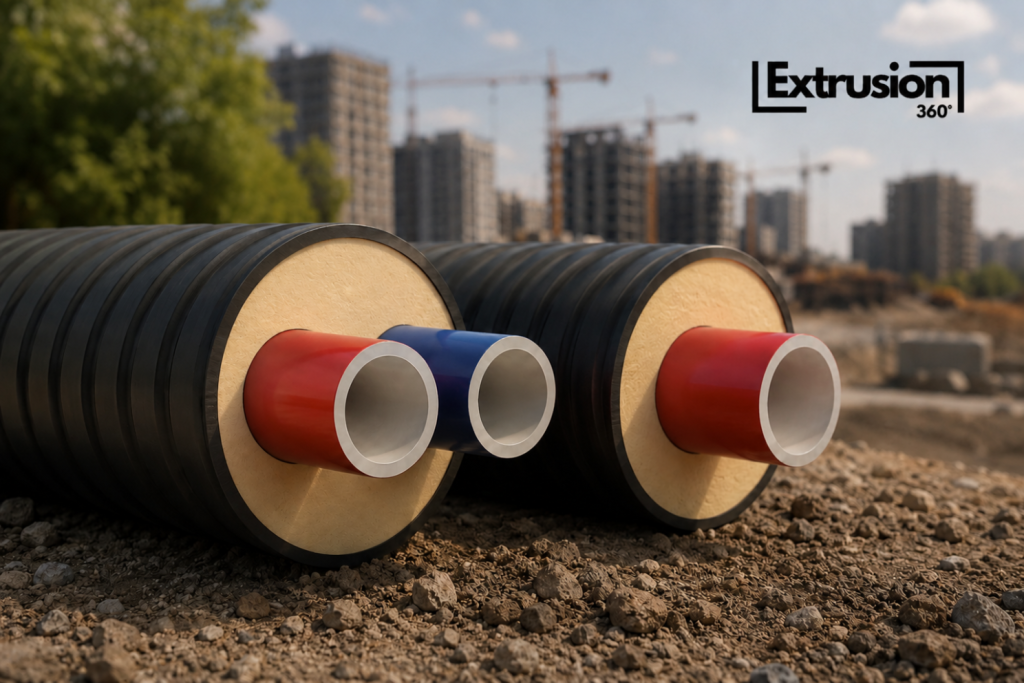
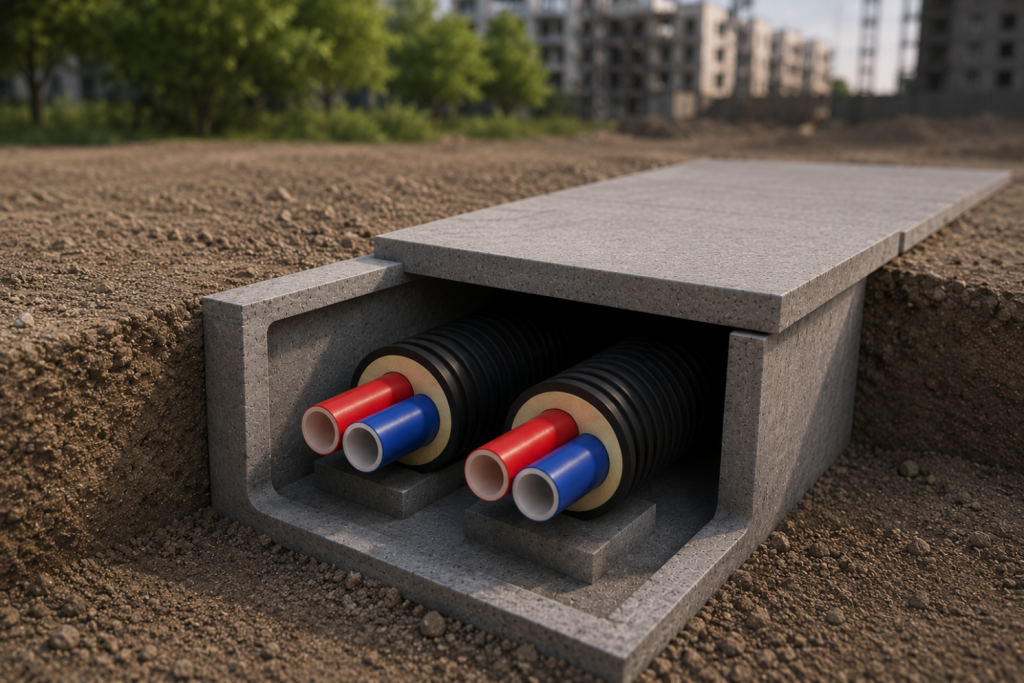
Modern buried district heating pipe is not a single tube but a factory-manufactured layered assembly composed of three functional components.
The innermost layer is the service pipe, which carries the hot or chilled water under pressure. Depending on operating temperature and network scale, this is typically carbon steel, PEX-a, PE-RT, or PB.
Surrounding the service pipe is rigid polyurethane foam (PUR), which provides thermal insulation and reduces heat loss into the surrounding soil.
The outer layer is a high-density polyethylene (HDPE) casing that protects the insulation from groundwater ingress, chemical exposure, and installation damage.
In bonded systems, these layers function structurally as a single unit. The PUR foam adheres both to the service pipe and the HDPE casing, allowing thermal expansion forces to transfer into the surrounding soil through axial shear interaction.
EN 253 defines this bonded pipe structure for steel-based district heating systems, including requirements for thermal conductivity, foam adhesion, long-term ageing behaviour, and mechanical performance. Flexible polymer systems are generally covered under the EN 15632 series.
Steel remains the standard choice for high-temperature and large-diameter transmission networks. EN 253 systems commonly operate at temperatures up to 120 °C continuous service with occasional peaks approaching 140 °C. Steel handles high pressure and very large diameters effectively, although it requires field welding and remains vulnerable to external corrosion if moisture penetrates the casing system.
PEX-a is a cross-linked polyethylene manufactured using the peroxide-based Engel method. Cross-linking occurs during extrusion while the polymer remains above its crystalline melting temperature, producing a highly uniform molecular network throughout the pipe wall. Under EN 15632 applications, PEX-a systems are commonly engineered for long-term operation under defined pressure-temperature profiles, with some manufacturers projecting service lifetimes approaching 100 years at moderate operating temperatures around 80 °C. Depending on system design, operating temperatures may reach up to 95 °C with pressure classes around PN10. PEX-a is corrosion-resistant and supplied in long flexible coils, reducing field joints and accelerating installation.
PE-RT, or polyethylene of raised temperature resistance, achieves elevated temperature performance through its molecular structure rather than cross-linking. PE-RT Type II systems are commonly used in low-temperature district heating networks operating roughly within the 70 to 80 °C range, subject to pressure class and design life requirements.
PB, or polybutylene, is also used in flexible district heating systems under EN 15632. It offers good creep resistance at elevated temperatures and similar operating ranges to PE-RT, although its global supply base is smaller.
In practical engineering terms, steel dominates high-temperature transmission systems, while flexible polymers increasingly serve distribution and service-line applications.
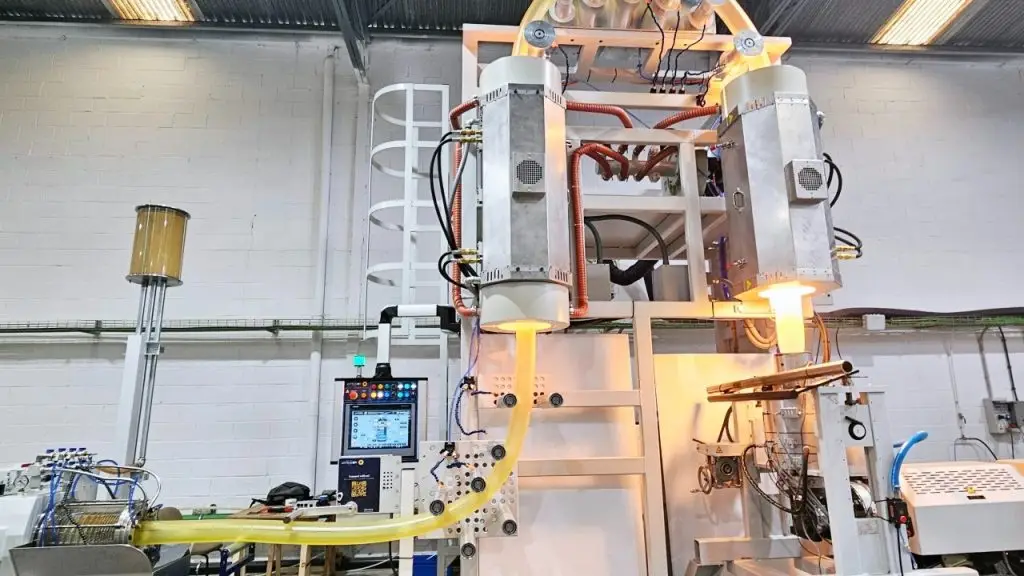
Among flexible polymer pipe systems, PE-Xa is widely regarded as one of the highest-performance options for district heating applications due to its combination of thermal stability, flexibility, creep resistance, and long-term durability under cyclic thermal and pressure loading. The peroxide-based Engel manufacturing process, typically using infrared (IR) crosslinking technology, creates a highly uniform crosslinked structure throughout the pipe wall. This improves resistance to thermal ageing, slow crack growth, and stress cracking compared with non-crosslinked polyethylene systems.
PE-Xa systems can also accommodate thermal expansion and minor ground movement effectively while maintaining excellent corrosion resistance. Their suitability for long continuous coil lengths can help simplify installation and reduce long-term maintenance requirements.
For modern fourth-generation district heating networks, these characteristics make PE-Xa particularly attractive for distribution and service-line applications where operational reliability, energy efficiency, and lifecycle cost are increasingly important engineering considerations.
District heating networks are tiered, and the pipe diameter steps down as the flow splits toward end users.
Transmission lines carry the full plant output between heat sources and major distribution nodes. These are dominated by steel under EN 253 and commonly run from around DN 300 up to DN 800, with the largest schemes reaching DN 1000 or DN 1200. Design velocities sit in the 1.5 to 2.5 m/s range, since pumping cost per delivered MWh is small at large diameters.
Distribution networks branch off the transmission backbone and feed neighbourhoods or building groups. They typically sit in the DN 100 to DN 300 band, occasionally lower, with design velocities of 1.0 to 1.5 m/s. This is the part of the network where polymer systems are now competing seriously with steel, especially where flow temperatures have been lowered.
Service lines are the final connection from the distribution main into a building or substation. These run from roughly DN 20 to DN 80 in most networks, sometimes up to DN 100 for larger buildings. Design velocities are kept low, around 0.5 to 1.0 m/s, to control noise and pressure loss. This is the natural domain of flexible polymer pipes, since they arrive on coils and can be pulled directly into the trench with very few joints.
Pipe sizing in practice is set by mass flow, an allowable velocity in the ranges above, and a maximum specific pressure loss, typically 100 to 200 Pa/m.
The point of all this layered structure is to hit four numbers that decide whether a network works.
Heat loss is the first. Network losses scale directly with foam lambda, with insulation thickness, and with the supply and return temperatures. Hitting λ50 below 0.029 W/(m·K) under EN 253, combined with the move to lower flow temperatures, is what makes modern networks viable in low heat density areas.
Thermal expansion is the second. Steel expands roughly 1.2 mm per metre per 100 °C of temperature change, so a 1 km transmission pipe going from 10 °C ambient to 120 °C operation wants to grow by more than a metre. Bonded systems handle this either by pre-stressing during installation (heating the pipe before backfill) or by relying on soil friction on the casing to restrain the pipe, with the foam transferring shear from steel to casing. PEX-a expands more per kelvin than steel, but it operates at lower temperature swings and on smaller diameters with much greater flexibility, so the absolute movement is easier to absorb in the trench.
Pressure capability is the third. Steel under EN 253 is typically specified at PN 16 or PN 25 in transmission and distribution work. Flexible polymer systems under EN 15632 are rated up to 10 bar at 80 °C with a 30-year design life. That is enough for distribution and service lines in most networks, but it is part of the reason transmission backbones stay in steel.
Installation method follows from all of this. Steel pipes are welded section by section in the trench, X-rayed at the welds, then foam-jointed at the field joints to restore the casing and insulation. Polymer pipes arrive coiled, sometimes hundreds of metres on a single drum, and are pulled in with very few joints. The cost difference at the service-line and distribution level is significant, both in labour hours and in trench open time.
EN 253 and EN 15632 define minimum design-life qualification criteria rather than fixed real-world service-life limits. These standards rely on accelerated ageing procedures and Arrhenius-based extrapolation methods to evaluate long-term performance under defined operating conditions.
While many district heating pipe systems are commonly qualified around 30-year design conditions, field experience across Scandinavia and other European markets shows that properly installed and well-maintained systems can often remain operational for 50 years or more when moisture ingress is prevented and operating temperatures are carefully controlled. In low-temperature district heating applications, PE-Xa systems are also increasingly associated with projected service lives approaching 100 years under favorable operating conditions.
The actual service life of a district heating pipe depends on several interacting factors, including manufacturing quality, installation quality, moisture protection, operating temperature, and long-term thermal and mechanical loading. Among these, moisture ingress remains one of the primary causes of insulation degradation and external corrosion in buried pipe systems.
Replacing entire networks is not financially realistic for most operators. The combined book value of a national or large municipal DH network is measured in billions of euros, and renewal rates of one to two percent per year mean a full network turnover would, in arithmetic terms, take many decades.
The practical answer is a maintenance and monitoring strategy that lets operators target intervention to where it matters. Modern toolkits combine alarm wire monitoring inside the casing for moisture detection, thermal imaging to spot insulation faults, ultrasonic wall-thickness measurements on steel service pipes, and digital asset management platforms that fuse GIS, pipe age, repair history, and live network data. The goal is to make repair-versus-replace decisions on evidence rather than age alone.
The sustainability case for repair is strong. The largest CO2 contributions during a replacement project come from steel and concrete production for new components, diesel for excavation and haulage, and the carbon embedded in trench reinstatement. Targeted rehabilitation, particularly of the casing and field joints, often avoids most of that without compromising the network’s integrity. Several lifecycle studies of DH renewal projects in Europe have reached the same conclusion: extending the life of a pipe by avoiding unnecessary replacement is usually the lower-carbon and lower-cost option.
Three trends are reshaping the pipe side of the industry, and they reinforce each other.
The first is the move to low-temperature district heating. Lund and Werner’s definition of fourth-generation district heating (4GDH) is built around supply temperatures below 70 °C, and sometimes as low as 50 °C, matched to renovated and new building stock with lower flow-temperature requirements. Fifth-generation systems run near ambient and use heat pumps at each connection. Lower temperatures cut network losses (estimates from the literature suggest reductions on the order of around 30 percent moving from third to fourth generation), unlock waste heat from industry and data centres, and put polymer service pipes inside their comfortable operating range rather than at the edge of it.
The second is the growing role of digitalisation. Networks that integrate multiple heat sources, including waste heat from industry and data centres, large heat pumps, biomass, solar thermal, and geothermal, need real-time visibility and control. The same digital backbone that enables predictive maintenance also enables prosumer connections, where buildings with surplus heat feed back into the network via a third pipe, sometimes called a collector. This is one of the more interesting structural shifts in the network architecture itself.
The third is the steady expansion of polymer systems into diameters that used to be steel-only. PE-Xa pipes have traditionally been used mainly for service connections, but they are increasingly being adopted in distribution networks as larger pipe diameters become commercially available. This is where the manufacturing capability of the supplier becomes the limit, not the underlying material physics.
Intelligent Extrusion Systems manufactures PE-Xa pipe extrusion lines capable of producing pipes up to 140 mm diameter, positioning the company among the larger technology suppliers in the PE-Xa district heating sector. This production capability supports the growing market demand for larger-diameter PE-Xa pipes used in neighborhood-scale distribution networks and secondary district heating infrastructure.
As fourth-generation district heating systems continue expanding across world, larger PE-Xa pipe dimensions are becoming increasingly important for connecting decentralized renewable heat sources, heat pumps, geothermal systems, and energy-efficient urban distribution networks.
For manufacturers planning to enter or expand PE-Xa pipe production, selecting the right extrusion technology is critical for achieving stable crosslinking quality, process reliability, and long-term production efficiency.
If you are planning a new PE-Xa pipe project or optimizing an existing extrusion line, feel free to get in touch.